
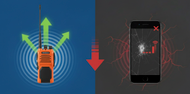
Two-Way Radios vs. Smartphones in Emergencies
When an emergency strikes your workplace, communication isn't just important—it's everything. The difference between a controlled evacuation and a chaotic one often comes down to whether your team can reach each other instantly and reliably.
Most facilities today rely on smartphones. They're everywhere, they're familiar, and they feel like enough.
But when the pressure is on—during a fire, a chemical spill, a power outage, or a security breach—smartphones regularly let teams down at the exact moment they're needed most.
This post breaks down five specific reasons why smartphones are poorly suited for workplace emergencies, and why purpose-built two-way radios remain the gold standard for critical communication.
Reason 1: Cellular Networks Collapse Under Pressure
Picture a large-scale emergency at your facility.
Employees are calling for help, managers are trying to coordinate, and emergency services are being contacted—all at the same time.
The result? A congested network that can barely handle the load.
Cellular towers have a finite capacity. When a crisis triggers a surge in call volume, towers become overloaded and calls drop, messages fail to send, and data slows to a crawl.
This isn't a rare edge case—it's a well-documented pattern seen during natural disasters, industrial accidents, and large-scale evacuations.
Two-way radios operate on dedicated radio frequencies, completely independent of cellular infrastructure. There's no tower to overload, no network to congest. Push the button, and your message gets through—every time, to everyone who needs to hear it.
Reason 2: Smartphones Aren't Built for the Job Site
Consumer smartphones are engineered for everyday convenience, not industrial punishment. A cracked screen, a broken charging port, or water damage from a sprinkler activation can render a phone useless at the worst possible time.
Industrial two-way radios are built to a completely different standard:
- Drop resistance: Many models are rated to survive drops from 4–6 feet onto concrete
- Water and dust protection: IP67 and IP68 ratings mean full submersion tolerance
- Temperature tolerance: Radios function reliably in extreme heat and cold, where smartphones routinely shut down
- No touchscreens to fail: Physical buttons work with gloves on and in wet conditions
When your team is working in a warehouse, on a construction site, or in a manufacturing facility, that difference in build quality matters enormously. A radio that survives a drop into a puddle could be the device that gets everyone out safely.
Reason 3: Battery Life Is a Liability You Can't Afford
A typical smartphone battery lasts 8–12 hours under normal use. In an emergency, with screens on, calls being made, and data transmitting constantly, that number drops significantly. A phone that dies mid-crisis is worse than no phone at all—it creates a false sense of security right up until it goes dark.
Two-way radios are designed around long operational endurance:
- Most commercial radios deliver 16–24 hours of continuous use on a single charge
- Many models support hot-swappable batteries, so a fresh pack can be slotted in without powering down
- Standby time is measured in days, not hours
For emergencies that extend beyond a standard shift—severe weather events, extended lockdowns, complex search-and-rescue operations—that staying power is critical. Your communication infrastructure can't be the thing that fails first.
Reason 4: Push-to-Talk Wins When Every Second Counts
Calling someone on a smartphone takes time. You unlock the screen, find the contact, dial, wait for the line to connect, and hope they pick up. In a low-stakes situation, those extra seconds are trivial. During an emergency, they're not.
Two-way radios use push-to-talk (PTT) technology. Press a button, speak, release. Your message reaches one person, a group, or your entire team simultaneously—in under a second. There's no ringing, no voicemail, no missed call notification that gets checked ten minutes later.
The practical difference plays out like this:
- Radios: "All staff, evacuation route B is blocked. Use route A." Done. Everyone heard it at once.
- Smartphones: Call the supervisor, leave a message, text the team, wait for replies, follow up with anyone who missed it.
Fast, clear, one-to-many communication is exactly what emergency response protocols are built around. Radios align with those protocols in a way that smartphones simply don't.
Reason 5: Smartphones Go Silent Where You Need Them Most
Cellular dead zones are a real and persistent problem in many work environments. Basements, underground parking structures, server rooms, reinforced concrete buildings, remote outdoor sites, and large industrial facilities all have one thing in common: inconsistent or nonexistent cell signal.
You may have full bars at the front entrance and zero signal in the stairwell two floors below. In an emergency, your team doesn't get to choose where they are when they need to communicate.
Two-way radio systems are built to solve exactly this problem:
- Wide-area repeaters extend radio coverage across large campuses, multiple buildings, or underground floors
- Digital radio systems maintain clearer audio at the edges of coverage areas, where analog signal would otherwise degrade
- Infrastructure is yours: Unlike cellular, your radio network doesn't depend on a third-party carrier's infrastructure staying operational
For facilities with known coverage challenges, a properly configured radio system eliminates dead zones entirely. The communication works wherever your people are.
Assess Your Facility's Communication Readiness
Every workplace has its own risk profile. A hospital evacuation, a warehouse fire, a security incident at a corporate campus—each scenario demands fast, reliable, uninterrupted communication across your entire team.
Smartphones work well for routine coordination. But routine is precisely what emergencies are not. When the stakes are high, you need a communication system engineered for that pressure—one that doesn't depend on a carrier network, doesn't run out of battery at hour nine, and doesn't stop working because someone dropped it.
Take a close look at your current setup. Where are your coverage gaps? What happens to your communication plan if the cellular network goes down? How quickly can your team reach each other when every second matters?
A dedicated two-way radio system gives you clear, reliable answers to all three questions. If you're ready to assess your facility's needs and find the right radio solution, contact our team for a free consultation.