
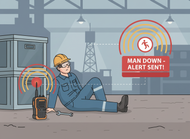
Man Down Feature: Two-Way Radios for Lone Workers
Every year, workers across high-risk industries face dangerous situations alone. A slip on a wet surface. A sudden medical emergency. Exposure to toxic fumes. When no one is nearby to help, every second counts.
That's where the Man Down feature on two-way radios becomes more than just a setting—it becomes a lifeline.
If your team includes lone workers operating in remote, hazardous, or physically demanding environments, understanding this feature could make the difference between a close call and a tragedy.
This post breaks down exactly how Man Down technology works, why it matters, and which industries stand to benefit most from equipping their teams with radios that have it built in.
What Is the Man Down Feature?
The Man Down feature is an automatic safety alert system built into select two-way radios. It's designed specifically for lone workers—employees who operate without direct supervision, often in environments where a fall or sudden incapacitation could go unnoticed for hours.
Here's the core idea: if a worker becomes incapacitated and stops moving, the radio detects it and triggers an emergency alert. No button press required. No need for the worker to call for help. The radio does it automatically.
This matters enormously in situations where a worker physically cannot reach out—whether they've been knocked unconscious, suffered a medical episode, or been injured in a fall.
How Man Down Technology Works
At the heart of the Man Down feature are two types of sensors: motion sensors and tilt sensors.
Motion Sensors
Motion sensors continuously monitor the worker's movement. If the radio remains stationary for a set period of time—usually configurable between 10 seconds and several minutes—it interprets this as a potential emergency. A pre-alert tone sounds first, giving the worker a brief window to cancel the alarm if they're simply standing still. If there's no response, the alert is automatically transmitted.
Tilt Sensors
Tilt sensors take it a step further. They detect changes in the radio's angle relative to vertical. When a worker falls, the radio shifts from an upright position to a horizontal one. The sensor recognizes this sudden change in orientation and triggers the alert, even if the worker is still technically moving (such as rolling on the ground after a fall).
Together, these two sensors create a robust detection system. The radio is constantly watching, so the worker doesn't have to think about activating an alarm in an emergency—which, realistically, they may not be able to do.
What Happens When an Alert Is Triggered?
When the Man Down alarm activates, the radio transmits an emergency signal to a dispatcher, supervisor, or designated response team. Depending on the radio model and system setup, this alert may include:
- The worker's identity (via their assigned radio ID or channel)
- GPS location data (on GPS-enabled models)
- An open audio channel, allowing responders to hear what's happening at the worker's location
This combination of real-time data gives emergency responders exactly what they need to act fast.
Why Real-Time Alerts Matter in High-Risk Environments
Speed is everything in an emergency. Research shows that survival rates in many workplace incidents—particularly those involving cardiac events or serious trauma—drop dramatically with every minute that passes without intervention. A worker who collapses alone, in a remote area, without anyone knowing, faces a very different outcome than one whose radio immediately alerts a response team.
The Man Down feature eliminates the dangerous gap between when an incident occurs and when help is dispatched. There's no reliance on a worker pressing an emergency button. There's no waiting for someone to notice the worker is missing. The alert goes out automatically and immediately.
For supervisors and safety managers, this real-time visibility is invaluable. You always know something has happened, and you know where to send help.
Industries That Benefit Most From Man Down Radios
The Man Down feature isn't a niche addition—it's a critical safety tool across a wide range of industries. Here are the sectors where it makes the biggest impact.
Construction and Engineering
Construction sites are among the most hazardous workplaces in the US. Falls from height, heavy machinery, and structural hazards create constant risk. Workers often operate in areas where colleagues may not have line of sight. A Man Down-enabled radio ensures that if a worker is struck by falling debris or loses their footing on scaffolding, an alert goes out instantly.
Oil, Gas, and Mining
Remote extraction sites, confined spaces, and exposure to toxic gases make oil, gas, and mining environments particularly unforgiving. Workers may be miles from the nearest colleague. In these settings, a Man Down feature isn't a nice-to-have—it's a non-negotiable part of a complete safety protocol.
Security and Law Enforcement
Security personnel—especially those working night shifts or patrolling large, isolated areas—face the risk of physical altercations or sudden medical emergencies. Man Down detection ensures that if an officer goes down and can't call for backup, the radio still does it for them.
Manufacturing and Warehousing
Heavy machinery, forklifts, and elevated platforms create significant injury risk on the warehouse floor. Many manufacturing facilities also use chemicals that can cause sudden health episodes. For workers operating independently during off-hours or overnight shifts, Man Down radios provide an essential safety net.
Utilities and Telecommunications
Electricians, line workers, and technicians often work alone at height or in confined spaces. Electrical incidents can render a worker instantly unconscious. In these scenarios, manual emergency activation is simply not possible—making automatic detection critical.
Healthcare and Aged Care
Nurses and care workers who conduct home visits or work in large facilities often find themselves alone with patients in vulnerable situations. A Man Down feature protects the carer as much as the patient, ensuring that if a worker is assaulted or has a medical episode during a home visit, help is on the way.
What to Look For When Choosing a Man Down Radio
Not all radios with a Man Down feature are built the same. Here's what to prioritize when evaluating options for your team:
- Configurable sensitivity: adjust how quickly the alert triggers to reduce false alarms
- GPS integration: location data helps responders find workers faster
- Durability ratings: look for MIL-STD-810 or IP67-rated models
- Battery life: aim for 12+ hours on a single charge
- Compatibility with your existing systems: ensure dispatch and monitoring integration
Choosing the Right Communication Hardware for Employee Protection
The Man Down feature is one of the most powerful safety tools available to employers with lone workers—but only if it's implemented correctly. Choosing a radio with the right sensitivity settings, durable construction, and reliable range is just as important as the feature itself.
Before purchasing, assess your environment. How remote are your workers? What are the specific hazards they face? How quickly can your response team reach them once an alert is triggered? The answers to these questions will guide you toward the right hardware.
If you're unsure where to start, talk to a two-way radio specialist who understands your industry. The goal isn't to buy the most expensive radio on the market—it's to equip your team with the right tool for the job, so that when the worst happens, your workers aren't facing it alone.