
The Best Two-Way Radios for Church Security (2026 Guide)
What Are the Best Two-Way Radios for Churches?
The Short Answer
The best two-way radios for churches are the Motorola CLS1110, Motorola CLS1410, and Motorola Curve. Each model addresses a different size and complexity of worship environment: the CLS1110 handles small to mid-size congregations needing single-channel communication on a budget; the CLS1410 provides four-channel role separation for larger teams covering nursery, security, A/V, and facilities; and the Motorola Curve delivers license-free digital performance for large sanctuaries, multi-building campuses, and churches with significant RF interference from audio equipment.
Church radio requirements are more nuanced than most venues assume. Low noise tolerance in the sanctuary, discreet form factors for ushers, long Sunday-morning battery duration, and the need to cover everything from a 5,000 sq ft single-campus church to a 200,000 sq ft megachurch campus.
But not all radios hold up in a church environment. Dead zones in portable classrooms, batteries that don’t last a full day, and devices that break after one drop can leave staff disconnected at exactly the wrong moment.
We've provided two-way radios to churches across the country since 1997. Here's what actually works, and why.
Why Churches Need Purpose-Built Two-Way Radios
Consumer walkie-talkies fail in church environments for reasons that are specific to worship settings: they produce audio squelch noise that disrupts a sermon or musical performance, their batteries rarely last a full Sunday schedule, and most lack the discreet form factor that ushers and hospitality teams require.
Churches operate with a set of operational demands that commercial two-way radio users in other industries don't always share:
Silence-critical environments. During a sermon, prayer, or musical performance, radio noise — squelch breaks, static bursts, or audible transmissions — is disruptive in a way that has no equivalent in a warehouse or restaurant. Professional radios address this with tight squelch settings, VOX (voice-activated transmission) with adjustable sensitivity, and earpiece accessories that route audio directly to the user's ear rather than a speaker.
Distributed role coverage. A typical Sunday morning operation requires simultaneous coordination across nursery staff, security volunteers, AV technicians, parking lot attendants, ushers, and facilities personnel. Without dedicated channels, every department competes for the same transmission window. Most professional church radios support four to eight discrete channels, allowing each team to communicate independently while a channel manager (typically the head usher or executive pastor) can monitor or bridge all groups.
Long operational windows. A full Sunday at a multi-service church runs six to eight hours from first arrival to final cleanup, often without an opportunity for staff to return to a charging station. Battery life is a real operational constraint, not a marketing footnote.
Multi-building and campus coverage. Many churches operate across multiple structures — a main sanctuary, a children's wing, a fellowship hall, an administrative building, and surface parking. Standard 1-watt UHF radios cover up to 200,000 sq ft indoors, which is sufficient for most single-building churches. Larger campus configurations benefit from 2-watt UHF models or digital radios operating in the 900 MHz band, which penetrates masonry construction more effectively.
Safety and emergency coordination. Churches are assembly occupancies under the International Building Code (IBC) and local fire marshal jurisdiction. NFPA 101 (Life Safety Code) governs emergency egress procedures for assembly occupancies, and real-time internal communication between staff is a practical requirement for executing an evacuation plan. Many churches also run licensed security volunteers who need to reach the front office and parking lots simultaneously — a multi-channel radio system supports this.
Medical emergencies. Churches that serve aging congregations or host large events carry meaningful probability of a cardiac or medical incident. AED coordinators and first-aid volunteers need immediate, reliable contact with the front office and with individuals who can direct emergency responders to the correct entrance. A single-channel radio system with clear protocol is far more effective than cell phones in this scenario.
What to Look for in a Church Radio
Quiet Operation and Audio Quality
For sanctuary use, the ideal radio either routes all audio through an earpiece or allows the speaker volume to be reduced completely while the radio remains on standby. The Motorola CLS series allows full volume adjustment, and the CLP series routes all transmission audio through a wired earpiece, producing zero ambient speaker noise. For AV teams and ushers in the sanctuary during service, earpiece-only operation is the correct configuration.
Battery Life
A full Sunday schedule from pre-service setup through post-service cleanup runs seven to ten hours. The radios recommended on this page are rated for 10 to 15 hours of operational use under typical transmission loads (the industry-standard 5% transmit / 5% receive / 90% standby duty cycle). For churches running multiple services back-to-back on a single charge, confirm battery life against your specific schedule — a 10-hour-rated radio is adequate for a two-service Sunday; a three-service day with setup and teardown may push the boundary and warrant a spare battery or multi-unit charger.
Channel Capacity
Small churches with a single unified team can operate on one channel. Churches with distinct operational departments — nursery, security, AV, ushers, parking, facilities — benefit from three to eight channels. The Motorola CLS1110 provides one channel (sufficient for teams under ten people). The CLS1410 provides four channels. The Motorola Curve provides ten channels and is the appropriate choice for large congregations with complex department structures.
Form Factor and Discretion
Ushers and front-of-house hospitality staff benefit from compact, professional-looking radios that don't call attention during a service. The Motorola CLS series at 4.5 inches tall and under 5 oz is a practical choice. For maximum discretion, the Motorola CLP series clips completely to a collar or lapel and routes all audio through a wired earpiece — no visible speaker.
Durability Rating
Church radios don't face the same punishment as construction or industrial radios, but they do get dropped, bumped, and occasionally left in a coat closet over a winter. Commercial-grade radios tested to MIL-STD-810 standards — which simulate years of field use including drop shock, temperature cycles, and vibration — provide meaningfully longer service life than consumer-grade walkie-talkies.
Recommended Two-Way Radios for Churches
1. Motorola CLS1110 — Best for Small Congregations and Single-Team Operations
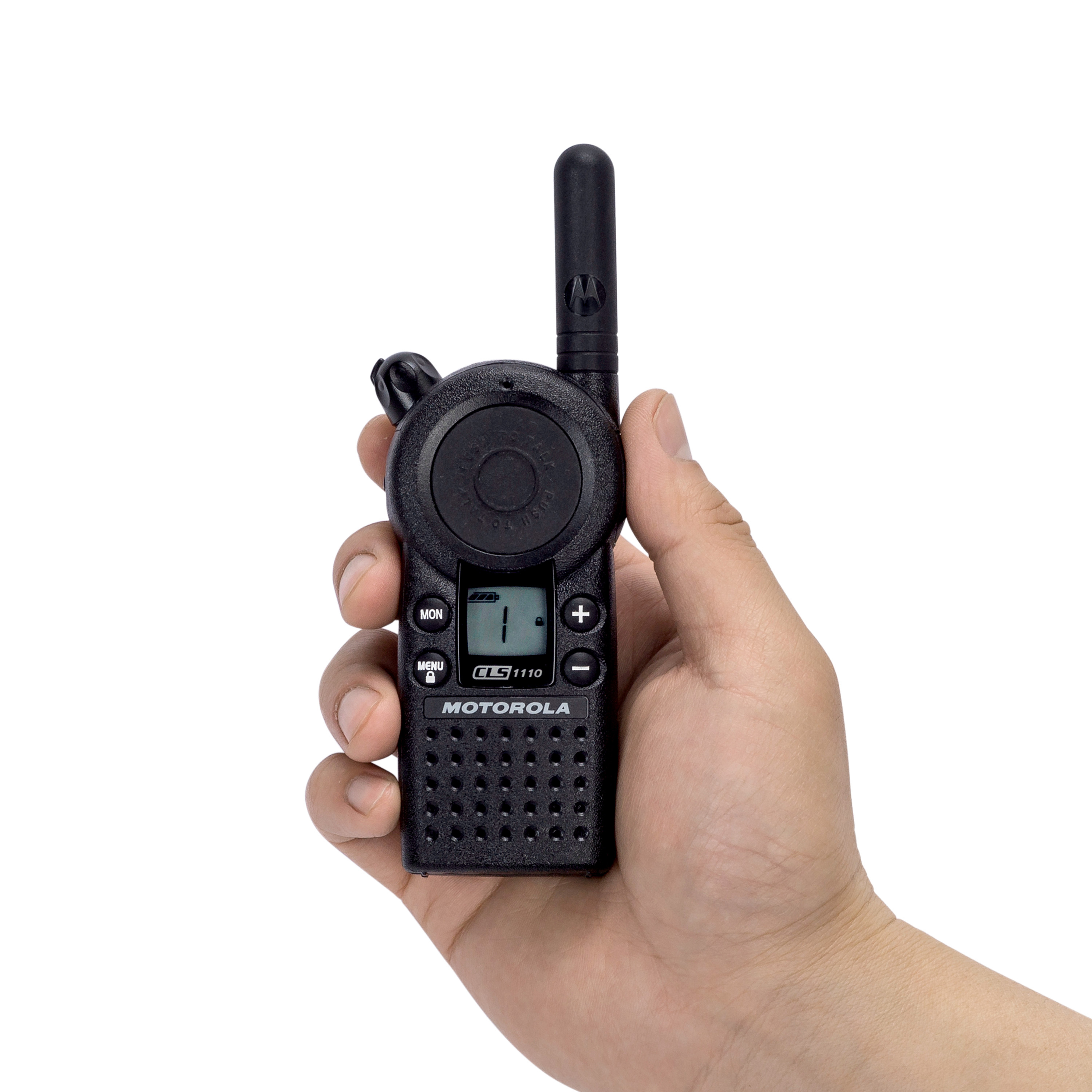
| Specification | Detail |
|---|---|
| Frequency | UHF (460–469 MHz) |
| Power | 1 watt |
| Channels | 1 |
| Indoor Coverage | Up to 200,000 sq ft / 15 floors |
| Battery Life | Up to 10 hours |
| Weight | under 5 oz |
The CLS1110 is the entry point for professional church communication. Its single channel is not a limitation for churches where the entire volunteer team operates as one unit — the usher team at a small or mid-size congregation, a children's ministry with a unified staff, or a facilities team that works independently from the rest of operations. The compact form factor (4.5 inches tall, < 5 oz) and professional finish make it appropriate for front-of-house use during a service.
Why it fits churches specifically
- 1-watt UHF provides reliable coverage through commercial construction materials — masonry, drywall, and glass partitions common in church buildings.
- Adjustable volume allows sanctuary use without routing all audio through an earpiece, provided staff stay in the lobby or hallways.
- Compatible with the full Motorola CLS accessory line, including discreet earpieces for in-sanctuary use.
- 10-hour battery life covers a standard Sunday morning start-to-finish.
2. Motorola CLS1410 — Best for Mid-Size Churches with Multiple Departments
| Specification | Detail |
|---|---|
| Frequency | UHF (460–469 MHz) |
| Power | 1 watt |
| Channels | 4 |
| Indoor Coverage | Up to 200,000 sq ft / 15 floors |
| Battery Life | Up to 10 hours |
| Weight | < 5 oz |
The CLS1410 is the most widely deployed church radio we sell. Four channels cover the most common church team structure: ushers/greeters, nursery and children's ministry, security, and facilities or AV. Each department stays on its own channel during service; a supervising pastor or operations coordinator can monitor or jump channels to reach any team without disrupting others. The hardware is identical to the CLS1110 — same size, same battery, same weight — with the addition of three extra channels.
Why it fits churches specifically
- Four-channel structure maps directly to the most common church department configuration: ushers, nursery, security, and facilities.
- VOX (hands-free voice-activated transmission) keeps ushers' hands free for door-holding, greeting, and distributing bulletins.
- Audible call alerts allow a channel supervisor to page a specific team without transmitting voice across all radios simultaneously.
- Compatible with the full Motorola CLS accessory ecosystem, including two-wire surveillance earpieces used by security teams.
3. Motorola Curve — Best for Large Churches and Multi-Building Campuses
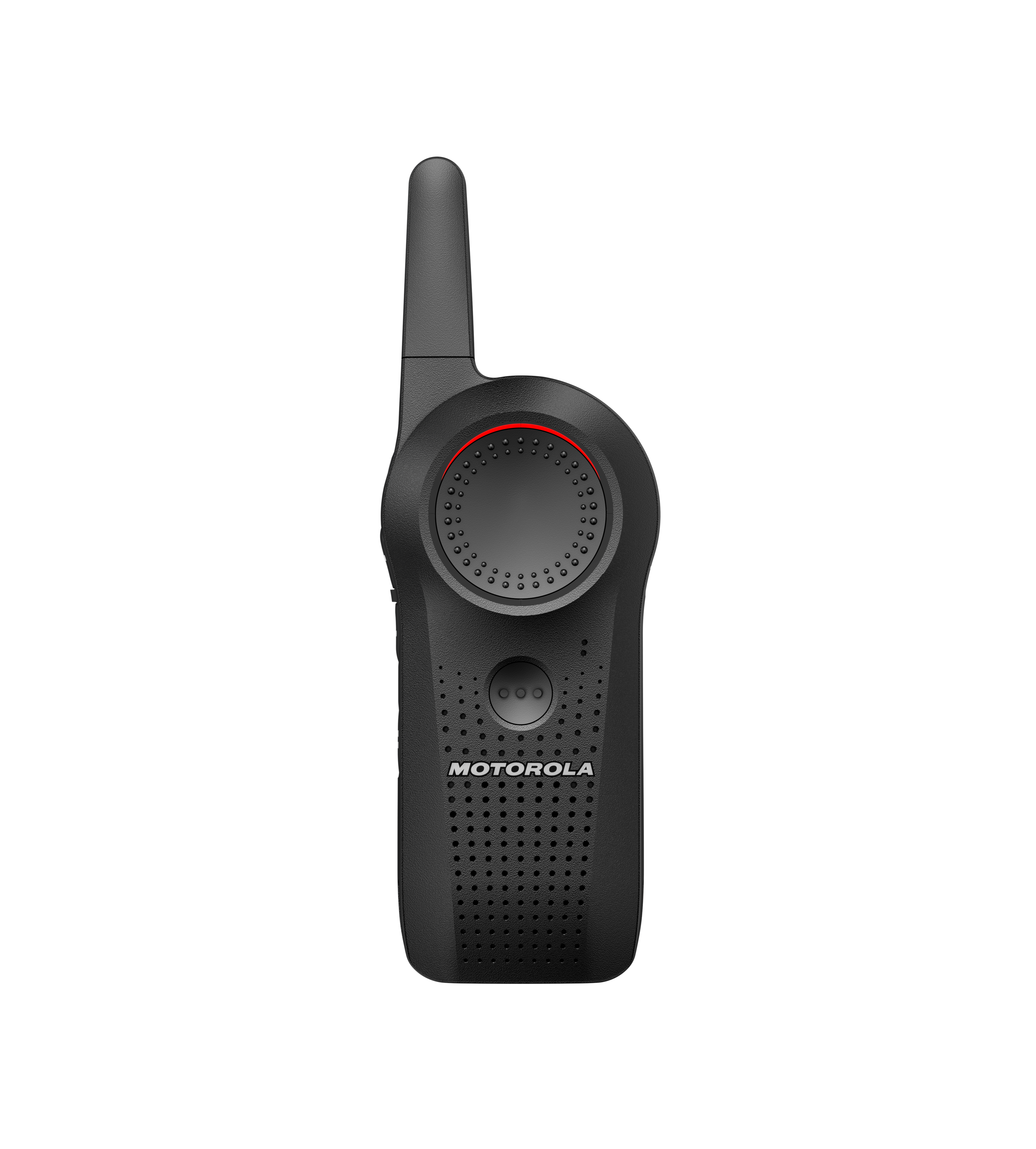
| Specification | Detail |
|---|---|
| Frequency | 900 MHz FHSS (frequency-hopping spread spectrum) |
| Technology | Digital |
| Channels | 10 |
| Indoor Coverage | Up to 300,000 sq ft / 30 floors |
| Battery Life | Up to 14 hours |
| Interference Resistance | High — FHSS hops across 75 channels per second |
The Motorola Curve is the correct choice for churches that have outgrown UHF analog radios — either because their campus exceeds the coverage capacity of a 1-watt UHF model, because wireless audio systems and sound board equipment create RF interference on UHF frequencies, or because they need more than four channels to support a complex volunteer structure. The Curve operates on 900 MHz using frequency-hopping spread spectrum technology, which hops across 75 channels per second and is essentially immune to the Wi-Fi interference and audio-system RF noise that plagues UHF radios in large sanctuaries.
Why it fits churches specifically
- 900 MHz FHSS is unaffected by the RF-dense environment inside large sanctuaries running wireless microphone systems, in-ear monitoring, and Wi-Fi networks simultaneously.
- 10 channels accommodate complex church org structures: sanctuary, overflow, lobby, nursery, children's, security, parking, facilities, AV/tech, and pastoral staff each on separate channels.
- 300,000 sq ft indoor coverage reaches adjacent buildings, covered walkways, and parking structures on a standard campus configuration.
- 14-hour battery life covers multi-service Sundays and mid-week events on a single charge.
- Compatible with Motorola Curve accessories including surveillance earpieces and speaker mics.
Model Comparison: Church Two-Way Radios at a Glance
| Model | Channels | Power / Technology | Indoor Coverage | Battery Life | Best For |
|---|---|---|---|---|---|
| Motorola CLS1110 | 1 | 1W UHF analog | 200,000 sq ft / 15 floors | Up to 10 hrs | Small congregations, single-team operations |
| Motorola CLS1410 | 4 | 1W UHF analog | 200,000 sq ft / 15 floors | Up to 10 hrs | Mid-size churches with multiple departments |
| Motorola Curve | 10 | 900 MHz FHSS digital | 300,000 sq ft / 20 floors | Up to 14 hrs | Large churches, multi-building campuses, RF-dense sanctuaries |
Also Worth Considering
Motorola RMU2080 — 2 watts, 8 channels, UHF (450–470 MHz), coverage up to 250,000 sq ft / 20 floors. A strong choice for churches that need more coverage headroom than the CLS1410 provides or require eight channels but want to stay on a UHF analog platform. Meets MIL-STD-810 C/D/E/F/G and IP55 sealing ratings.
Motorola RMU2040 — 2 watts, 4 channels, UHF (450–470 MHz), coverage up to 250,000 sq ft. An upgrade over the CLS1410 when the building's construction materials reduce the effective range of a 1-watt radio.
Coverage by Church Size: Matching Radio to Square Footage
| Church Type | Recommended Radio | Coverage Capacity |
|---|---|---|
| Small congregation, single floor under 10,000 sq ft | Motorola CLS1110 or CLS1410 | Up to 200,000 sq ft / 15 floors |
| Mid-size church, multi-room single building | Motorola RMU2040, RMU2080 | Up to 250,000 sq ft / 20 floors |
| Large church with multiple departments or buildings | Motorola Curve | Up to 300,000 sq ft / 30 floors |
| Multi-building campus or outdoor facilities | Motorola Curve or WAVE PTX (LTE/Wi-Fi) | Campus-wide or unlimited range (WAVE PTX) |
Churches with older masonry construction, concrete block walls, or RF-dense A/V environments should plan for reduced effective range relative to the rated sq ft. In these cases, step up one tier in the table above, or consider the Motorola Curve, whose 900 MHz FHSS signal penetrates structural materials more effectively than UHF analog.
Frequently Asked Questions
What is the best two-way radio for a church?
For most churches, the Motorola CLS1410 is the strongest all-around choice: four channels cover the most common department structure (ushers, nursery, security, facilities), 200,000 sq ft indoor coverage handles single-building churches of virtually any size, and the 10-hour battery life covers a full Sunday with multi-service schedules. For small congregations with a unified team, the CLS1110 is adequate. For large or multi-building campuses, or churches with RF interference from professional audio equipment, the Motorola Curve is the correct upgrade.
How much range do I need for a church radio?
For a single-floor church building under 20,000 sq ft, a 1-watt UHF radio like the CLS1110 or CLS1410 provides coverage well in excess of what is needed. The rated 200,000 sq ft indoor coverage gives substantial margin for signal degradation caused by wall materials and construction. For multi-story buildings, churches over 50,000 sq ft, or campuses with multiple structures, the 2-watt Motorola RMU2080 (250,000 sq ft / 20 floors) or the Motorola Curve (300,000 sq ft / 30 floors) are the appropriate choices. Churches with thick masonry or CMU block construction should plan for reduced effective range and step up one tier.
How long does the battery last on a church radio?
The Motorola CLS1110 and CLS1410 are rated for up to 10 hours at the standard 5/5/90 duty cycle (5% transmit, 5% receive, 90% standby). The Motorola Curve is rated for up to 14 hours. For a church running two morning services plus setup and teardown — a window of approximately seven to nine hours — a single charge is sufficient on any of the recommended models. Churches running three or more services or using radios across a full Sunday through evening programming benefit from a multi-unit charger that allows quick battery swaps between services.
Can two-way radios interfere with church sound systems or wireless microphones?
UHF radios operating near wireless microphone systems can create interference if frequency coordination is not observed. The Motorola CLS and RMU series use pre-programmed UHF frequencies that are generally separate from wireless microphone bands, but in environments with dense wireless audio deployments, some overlap risk exists. The Motorola Curve eliminates this concern entirely: its 900 MHz FHSS technology hops across 75 frequency channels per second and is designed to coexist with Wi-Fi, Bluetooth, and professional audio systems in RF-dense environments. For churches with large wireless microphone and in-ear monitor systems, the Curve is the recommended choice.
How many radios does a church need?
A practical starting framework is one radio per operational role per shift. A typical Sunday morning team might include: head usher, two to four floor ushers, nursery lead, one children's ministry coordinator, one security volunteer, and one facilities contact — suggesting seven to nine radios as a baseline. Larger churches with dedicated parking attendants, AV technicians, and pastoral liaisons often operate fifteen to twenty-five radios across departments. Tech Wholesale offers quick quotes for your team.
Are church radios suitable for security and emergency use?
Yes. Dedicated security channels allow security volunteers to communicate internally without broadcasting on the all-staff channel, and to escalate directly to pastoral leadership or call for medical assistance when needed. For churches that have designated AED responders or first-aid volunteers, a dedicated emergency channel with pre-assigned roles (AED coordinator, front door contact for EMS, pastoral response) provides a reliable framework that is faster than cell phones in a crowd. For assembly occupancies subject to NFPA 101 Life Safety Code, a functional internal radio system supports the coordination requirements of an emergency action plan.
What is the best way to keep radios charged for a full Sunday schedule?
The most reliable approach is to charge all radios overnight Saturday using a multi-unit charging cradle. The Motorola PMLN7136 six-unit multi-unit charger is compatible with the CLS series and allows all radios to be stored and charged simultaneously without managing individual charging cables. For churches with large fleets or multiple services that extend beyond ten hours, designating spare batteries and a hot-swap charging station in the lobby or back office is practical. The Motorola Curve's 15-hour battery life makes overnight charging sufficient for virtually any Sunday schedule without requiring a mid-day swap.
Can radios be used for children's ministry check-in and nursery operations?
Two-way radios are a standard communication tool for children's ministry staff in churches of every size. A dedicated nursery or children's ministry channel allows nursery staff to contact parents in the sanctuary without physically walking to the adult service — a significant operational improvement. The same channel can be used for child check-in alerts, medical concerns, and end-of-service pickup coordination. The compact CLS1110 or CLS1410 is appropriate for most nursery environments; earpiece accessories are available for staff who need quiet, discreet communication during class time.
Why Buy from TechWholesale.com
Tech Wholesale has been an authorized Motorola and Kenwood dealer since 1997. We've provided two-way radio systems to churches ranging from small rural congregations to multi-campus megachurches, and we understand the operational specifics of church communication in a way that general electronics retailers do not.
Every radio we sell carries the full manufacturer warranty — two years on commercial-grade Motorola models — and qualifies for manufacturer service and repair. We do not sell gray-market or refurbished units as new.
What sets us apart
- Lifetime technical support included with every purchase — call or email our team for the life of your radio fleet, not just during the warranty period. Most church radio questions we receive come years after the original purchase, and we're still here to help.
- Quick Quotes — Request a quote for your congregation's specific needs.
- Authorized dealer status — purchasing from an authorized dealer ensures your warranty is valid and your radios are covered by Motorola's repair network.
- Accessory expertise — we carry the full range of compatible earpieces, speaker-mic combinations, multi-unit chargers, and carry solutions for every model we sell. We can build a complete communication kit for your usher team, security volunteers, and nursery staff.
Shop CLS Series Radios Request a Church Radio Quote
Related Reading
On TechWholesale.com
- Motorola CLS1110 Product Page
- Motorola CLS1410 Product Page
- Motorola Curve Product Page
- Motorola RM Series Radios
- Motorola CLS Accessories
- Motorola Curve Accessories
- Two-Way Radios for Schools
- Two-Way Radios for Hotels
- Find My Radio: Radio Selection Guide
External Resources
- NFPA 101: Life Safety Code (Assembly Occupancies)
- FCC Consumer Guide: Two-Way Radios and Walkie-Talkies
- OSHA 29 CFR 1910.95: Occupational Noise Exposure
- Motorola Solutions: Business Two-Way Radios
Article by the Kristin Wood Two-Way Radio Specialist — Tech Wholesale | Authorized Motorola & Kenwood Dealer Since 1997 | Last Updated: June 2026